Case study · Inland
Hull Optimization of the New
Electric Mouettes Genevoises.
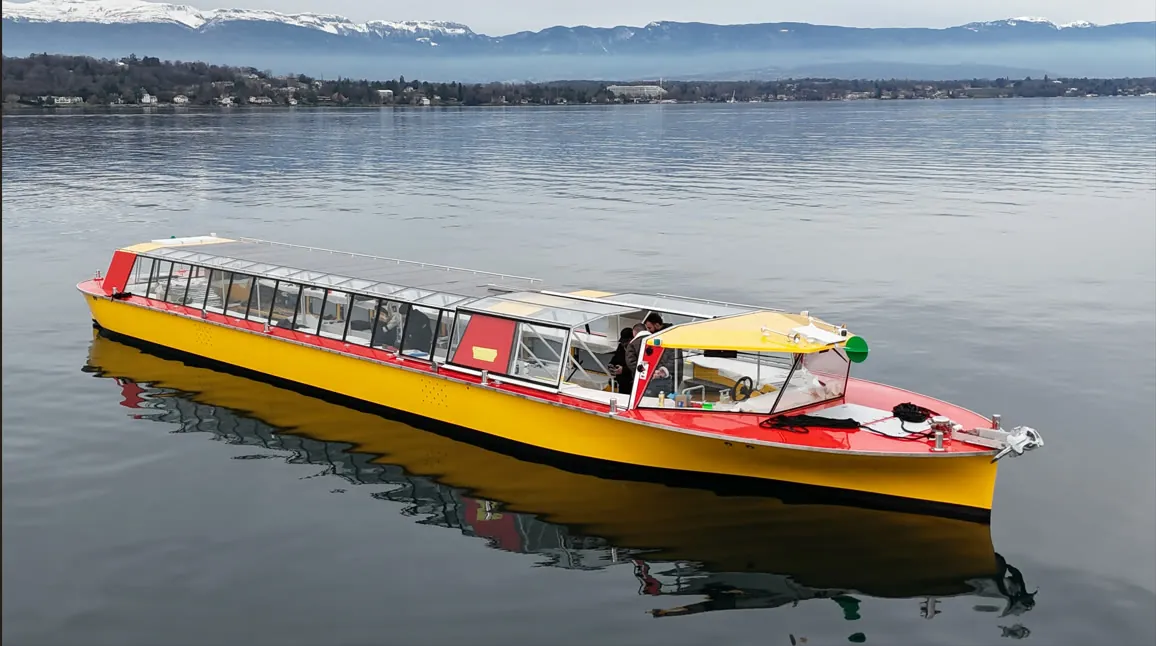
As part of the renewal of Geneva's iconic Mouettes Genevoises fleet, Scholl Technologies selected Nocean to optimize the hull of the new fully electric passenger vessel.
Project Overview
While the vessel is relatively small, the design challenge was particularly demanding. Unlike conventional optimization projects where performance can be improved by increasing dimensions or modifying the general arrangement, every design iteration had to comply with a strict set of architectural and operational constraints.
Engineering Challenges
The optimization had to simultaneously satisfy multiple requirements:
- Efficient operation in shallow water.
- Strict limits on the overall vessel height while maintaining comfortable standing height inside the cabin.
- Battery installation as low as possible to maximize transverse stability.
- Cockpit position providing excellent visibility for single-person operation.
- Passenger comfort and practical operability.
- Compliance with displacement, arrangement and production constraints.
These constraints significantly reduced the available design space, making conventional trial-and-error design impractical.
Computational Optimization
Rather than evaluating only a handful of candidate hulls, Nocean applied its automated CFD-based optimization workflow.
Over 200 different hull variants were generated, analysed and compared in less than one week, allowing the design team to explore a much larger portion of the design space than would be possible using traditional methods. Each design was evaluated using high-fidelity CFD simulations, ensuring that every candidate respected the imposed geometric and operational constraints while seeking the optimum compromise between resistance, stability and practical integration.
Results
compared with the reference design.
For an electric passenger vessel, this improvement delivers benefits far beyond reduced energy consumption:
- Increased operational autonomy.
- Greater resilience in adverse weather conditions, including strong winds and waves.
- Improved battery management.
- Larger operational safety margins.
- Lower lifetime energy consumption.
From Simulation to Reality
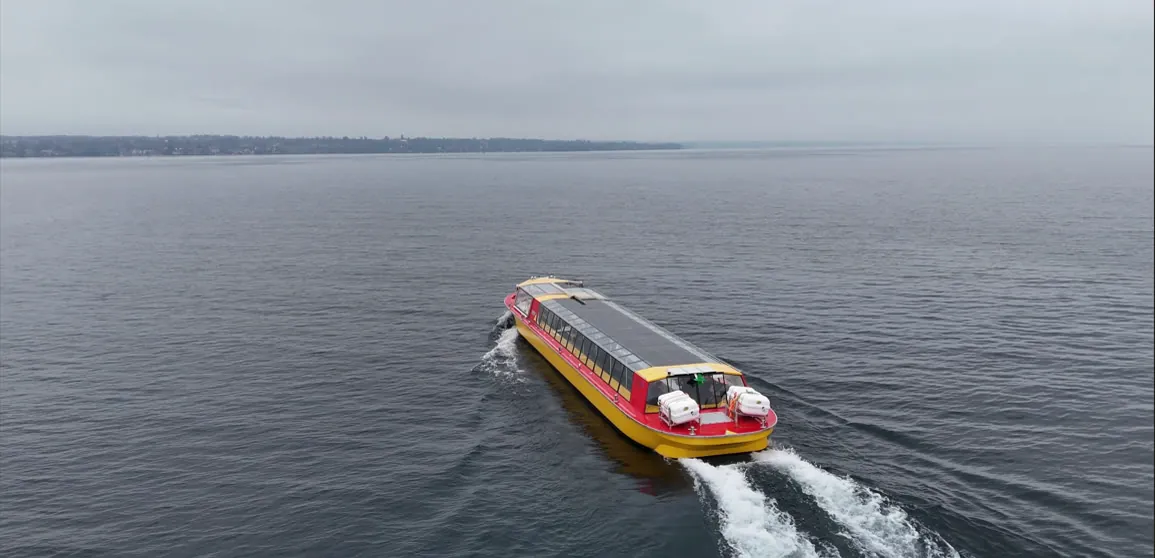
The vessel successfully completed its sea trials in December 2025 and is now operating daily on Lake Geneva.
This project illustrates how advanced numerical optimization can rapidly evaluate hundreds of design alternatives while respecting demanding engineering constraints, enabling measurable improvements in real-world vessel performance.